Members of the International Salvage Union (ISU) provided 231 services to vessels carrying nearly 3 million tonnes of potentially polluting cargo and fuel during operations in 2025.
Containerised cargo was up significantly at more than 1 million tonnes in ISU members’ services. The data come from the ISU’s Annual Pollution Prevention Survey for operations in 2025 which again demonstrates the vital role of professional salvors in protecting the marine environment.
President of the ISU, Leendert Muller, said: “ISU members are in most cases the only resource available to prevent a marine casualty from becoming an environmental disaster. This survey shows clearly how important our members are to the shipping industry but also to wider society. And we reduce the exposure of shipowners and their insurers to potentially huge costs and reputational damage.”
“Maintaining a professional salvage industry with the capability to deal with casualties and incidents wherever they occur is essential and needs to be properly funded. We are proud of the record which this survey confirms.”
There were 231 services in 2025 compared with 162 the previous year. A trend is for cases to get larger as classes of vessel increase in size, particularly containerships and also because of the amount of bunkers carried by the largest ships.
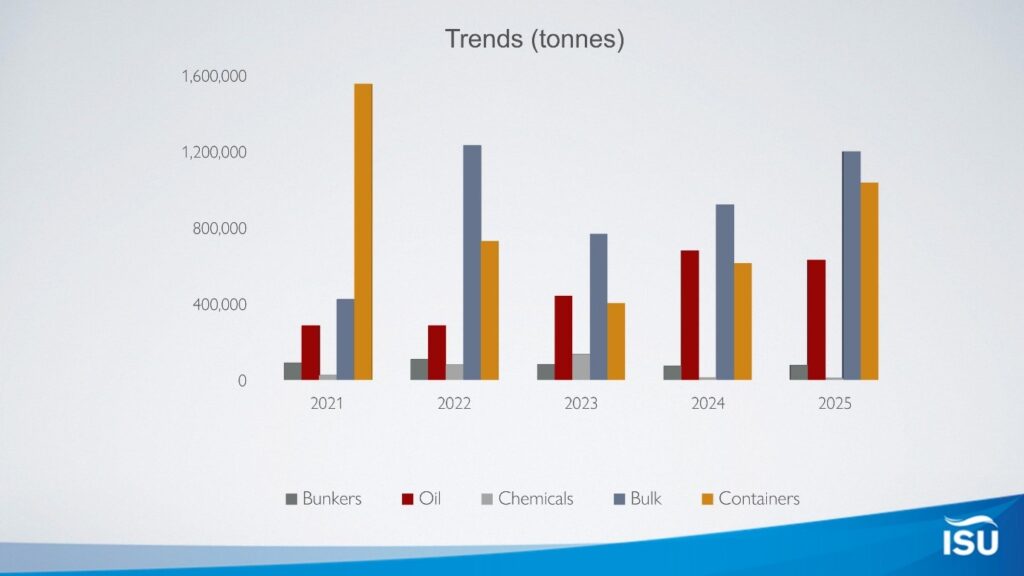
Each year there can be significant variations in the quantities of pollutants in each category. The number of containers in 2025 is notably higher than last year. Containers, after bulk cargo, remain the most significant category with ISU members providing services to vessels carrying 69,000 TEU amounting to just over 1 million tonnes of cargo. It compares with 506,000 tonnes of crude oil. It is now commonly accepted that containers carrying a great variety of harmful and dangerous goods including plastic pellets (nurdles) are one of the biggest threats to the marine environment.
Cargoes of refined oil products decreased in 2025 and there was very little chemical cargo recorded in the survey. Bulk cargoes in 2025 were 1.2 million tonnes. [See Editor’s note]. A number of the services in the survey did not record the quantity of bunkers or the cargo type meaning the reported numbers likely represent a more modest total than the reality.
2025 ISU Pollution Prevention Survey Results (tonnes)
| 2025 | 2024 | |
| Number of services | 231 | 162 |
| Bunker fuel | 77,359 | 73,747 |
| Crude oil | 505,734 | 399,817 |
| Refined oil products | 126,431 | 281,481 |
| Chemicals | 8,722 | 11,298 |
| Bulk
[see Editor’s note] |
1,203,497 | 923,433 |
| TEU – tonnes equivalent | 1,038,840 (69,256 TEU@nominal 15 tonnes/TEU) | 614,610 (40,974 TEU@nominal 15 tonnes/TEU) |
| Other pollutants | 11,240 | 92,659 |
| Totals | 2,995,936 | 2,397,045 |
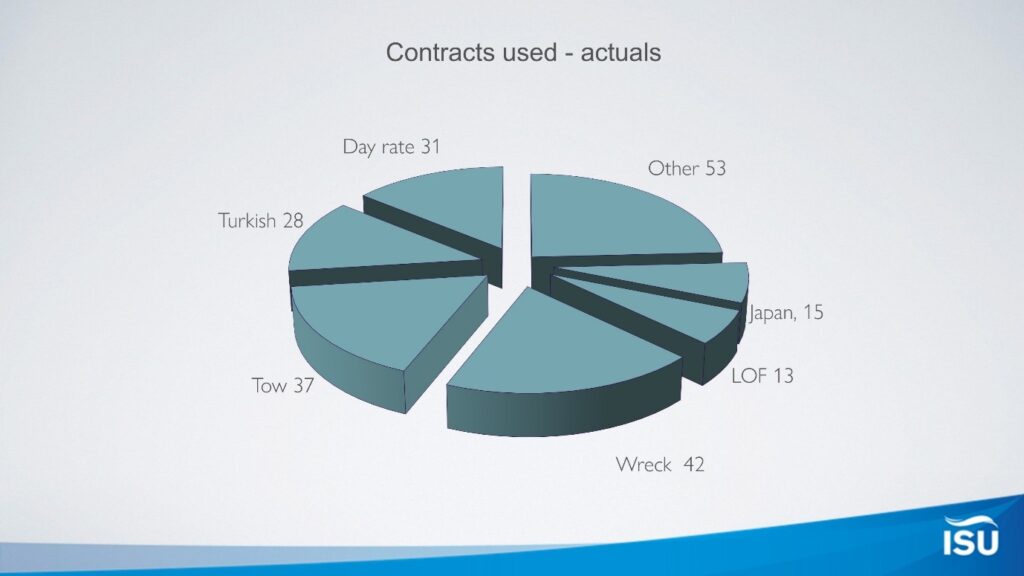
The 231 services in 2025 included 42 wreck removal/marine services contracts; 13 Lloyd’s Open Forms; 37 towage contracts; 15 Japanese Forms; 12 fixed price/lump sum, 31 day rate contracts; 53 other contracts (including commercial terms) and 28 Turkish Forms.
Leendert Muller concluded: “Many of these cases might have had real consequences and everyone in the shipping industry should ask the question ‘what if nothing had been done because no contractor was available’”.
ISU is transparent in noting that not all the potential pollutants were at immediate risk of going into the sea. Some cases will have had limited danger, but others will have carried a real risk of causing substantial environmental damage.
The survey was first conducted by ISU in 1994, and the methodology was updated in 2014 to include a wider range of potential pollutants including containers and hazardous and dirty bulk cargoes. In the period 1994 to end-2025, ISU members have provided services to casualty vessels carrying 48,790,081 tonnes of potential pollutants, an average of 1.5 million tonnes per year.
Editor’s note: The 2025 survey uses a new data collection form which includes all bulk cargo and does not separately identify hazardous/polluting bulk cargo.